





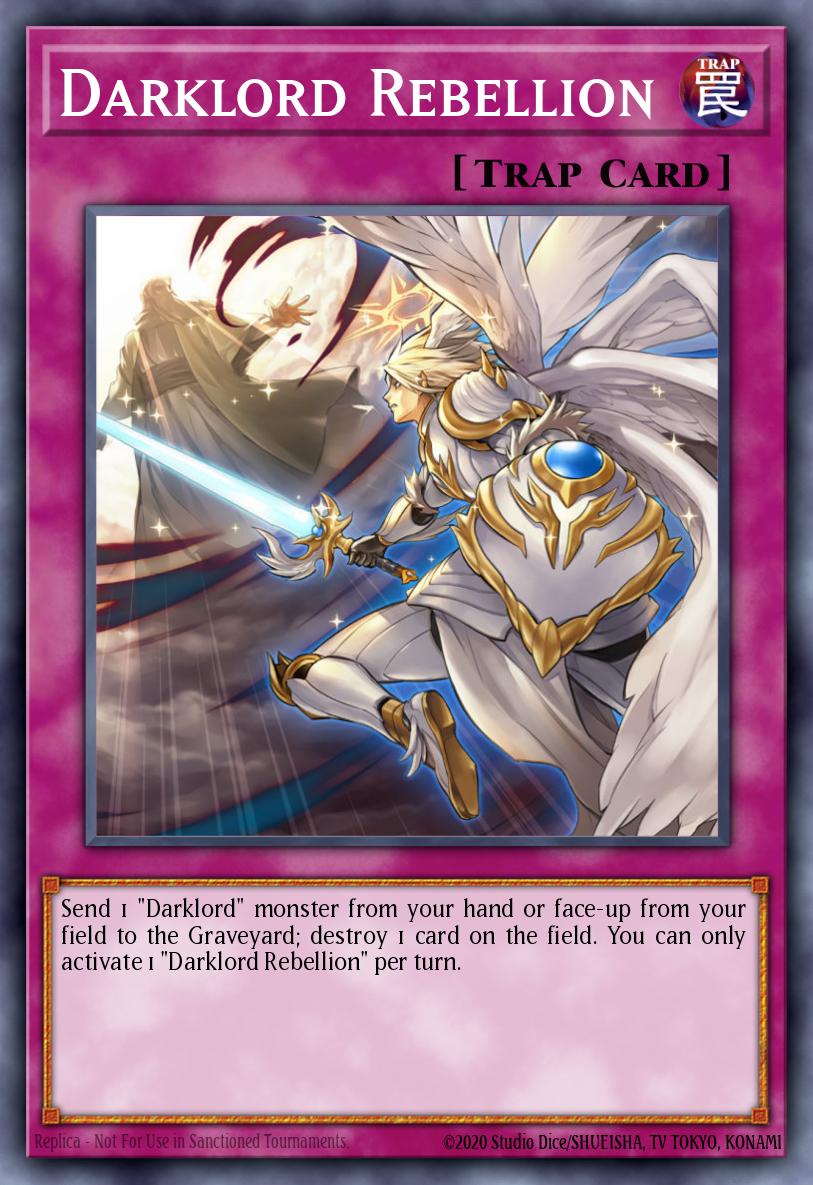

 Trap
 Normal
Darklord Rebellion
Archetype:
Darklord
View:
4430
Send 1 "Darklord" monster from your hand or face-up field to the GY; destroy 1 card on the field. You can only activate 1 "Darklord Rebellion" per turn.
Darklord Rebellion — Power Evaluation
Final Score: 53 ± 8 · Confidence: Medium
- Intrinsic: 52 · Deck: 54 · Meta: provisional
- Primary role: Removal / Negation
Why it scores here
Darklord Rebellion is a normal trap that converts one Darklord monster from hand or the face-up field into one untargeted destruction of any card on the field, once per turn. Its power comes from the removal it provides and from a deck that almost always has a Darklord available to pay the cost, both of which earn points. The 400/400 deck inclusion and the 33 archetype labels are mostly a sign of how often the Darklord shell runs it, not of its strength, so they moved the score only slightly. Its recorded boards are low-impact (average power index 18, no starter, searched, material or payoff role), so the card earns almost nothing for combo conversion.
Axis scores
| Axis | Score | Evidence |
|---|---|---|
| Accessibility | 65 | Needs a Darklord in hand or on the face-up field, and 400 of 400 sampled decks run it, so access is reliable within the shell (observed, deck stats; no starter role or searched-for role appearances). |
| Combo & Conversion | 25 | Only 2 recorded boards, both with power index 18 and no combo role; the card builds nothing by itself (observed, combos; text-verified: the effect is removal only). |
| Resource Economy | 50 | Trades one Darklord for one field card, roughly even; the sent monster can be recycled through the Darklord graveyard theme (inferred, text and guide snippets). |
| Effect & Interaction | 60 | Destroys any one card on the field with no targeting restriction, once per turn, so it is a flexible removal effect but is a slow trap that needs setup (verified text, inferred timing). |
| Material Utility | 5 | A Trap Card cannot serve as Extra Deck material or a level or name body (verified: card type Trap). |
| Resilience & Flexibility | 35 | A set normal trap that a single negation or hand-trap response can stop, and it is limited to one activation per turn (inferred from text and frame type). |
| Deck-Building Efficiency | 55 | Single-copy slot in a near-universal Darklord list with no garnet lock, but it only functions inside Darklord-compatible decks (observed, copies per deck avg 1.04). |
Calculation
Weight profile: Primary role Removal/Negation profile; no secondary role blended. Intrinsic ≈ 52, Deck ≈ 54, Meta = provisional. Modifiers: none. Final formula: 0.40*Intrinsic + 0.60*Deck
Strengths
- Flexible untargeted removal: destroys any one field card, including set cards
- Reliable access to its cost inside the Darklord shell (present in all 400 sampled decks)
- Cheap single-copy slot with no garnet or lock burden
Weaknesses
- Requires a Darklord monster in hand or on the field to activate
- Slow normal trap: needs to be set and survive a turn before use
- Recorded boards show almost no combo conversion (power index 18)
- Limited to one activation per turn
Counters / choke points
- Opponent negation of the activation (inferred from trap type; no card-specific counters in evidence)
- Opponent removal or destruction of the Darklord cost monster before activation (inferred)
Best use
Removal / interaction slot inside Darklord-compatible decks. Decks: Darklord, Power Patron, Forbidden, Despia, Artmage. Suggested copies: 1.
Evidence & gaps
- Verified: Card text: send 1 Darklord monster from hand or face-up field to GY, then destroy 1 card on the field; once per turn; Card type is Trap Card; cannot be Extra Deck material; Appears in 400 of 400 sampled decks at 1.04 average copies
- Observed: Appears in 100% of 2 recorded combos with average power index 18 and no starter, searched, material or payoff role; Top partners are almost entirely Darklord cards, so the card sits inside one shell
- Inferred: Normal trap timing means it must be set and survive a turn before use; Sent Darklord monsters can be recycled, so the cost is partly recoverable; Negation or hand-trap interaction on the activation is the main way to stop it
- Data gaps: no banlist token — assumed 3 copies (unlimited) only 2 recorded combos, too few to measure combo role distribution no card-specific rulings or Q&A in evidence usage statistics covers 4 archetype rows only